2 · 2026
Vicky, a voice assistant for a clinic
Books medical appointments and answers patients’ questions out loud. Built on Dialogflow, a FastAPI webhook and Gemini over OCR-processed documents, and it doesn’t make things up when it doesn’t know.
- 9/9
- unanswerable questions handled without hallucinating
- 18/18
- correct answers with vector retrieval
- 2.1 s
- median turn time in a spoken conversation
- 313
- automated tests
Channels
- Voicemicrophone, ends on silence
- Telegrammessages and buttons
Dialogue
- Dialogflow ESnative STT and TTS, 13 intents
Rules
- FastAPI webhookID regex, scheduling, SSML
Retrieval
- FAISSpassages closest to the question
Answer
- Geminidocuments only, or NO_DISPONIBLE
- Documents D1–D5scanned JPGs, fictional
- Tesseract OCRSpanish, with preprocessing
- Regexprice and schedule validation
- Indexpassages and embeddings, loaded at startup
Problem
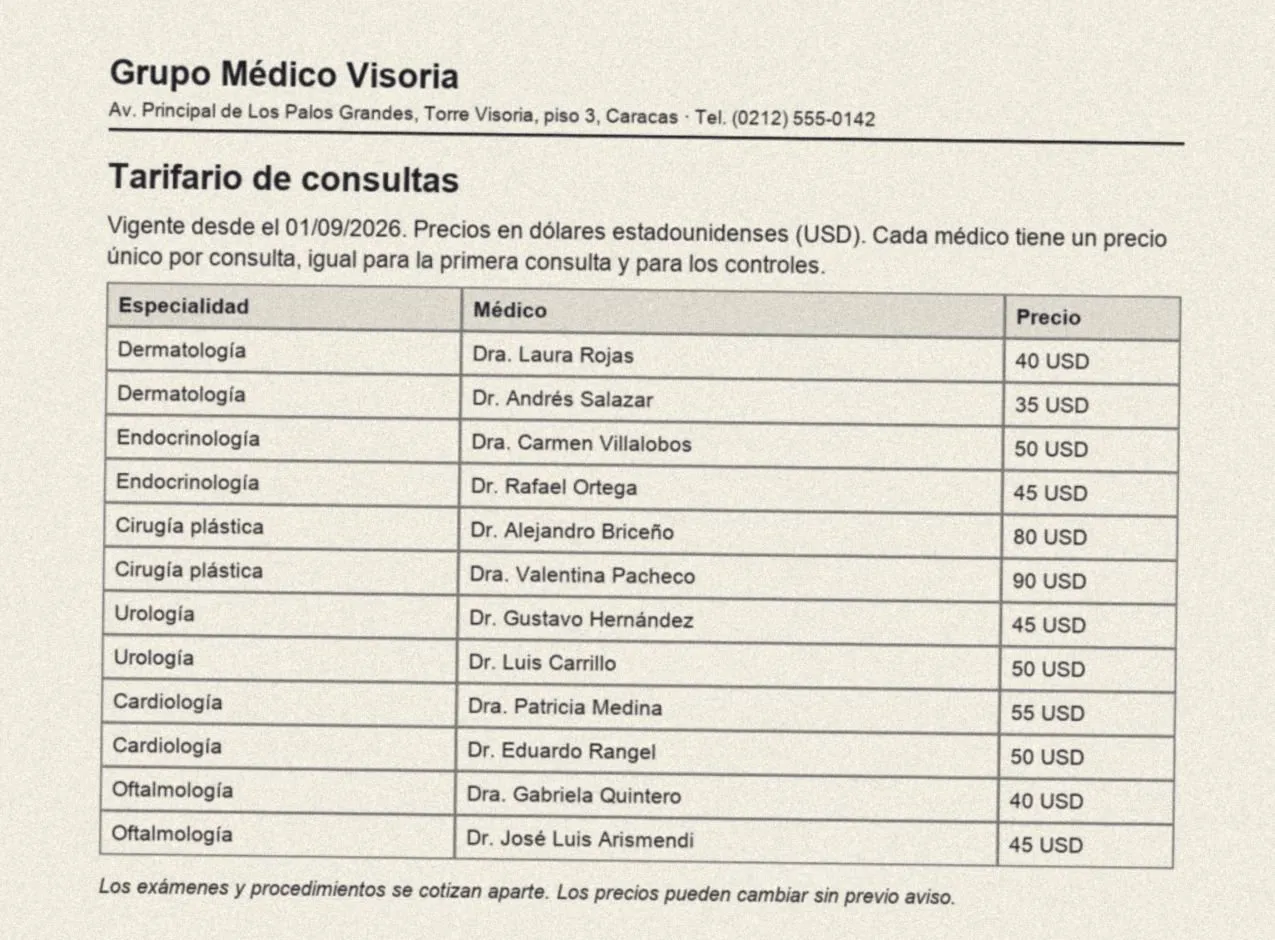
The front desk at a clinic, Grupo Médico Visoria (six specialties, twelve doctors), handles two kinds of phone calls: booking an appointment and asking common questions about prices, opening hours, insurance or directions. Vicky handles both by voice. In a healthcare setting, a made-up answer is worse than no answer. All clinic, doctor and patient data is fictional.
Approach
A spoken request makes a single round trip:
- The voice client records until it detects silence and sends the audio to Dialogflow, which transcribes it and classifies the intent.
- A FastAPI webhook applies the clinic’s rules: it validates the national ID with a two-level regex, respects each doctor’s real schedule, recognises returning patients and offers them the same doctor.
- For common questions, the webhook retrieves the closest passages of five clinic documents (OCR’d beforehand) from a FAISS index and sends only those passages to Gemini.
- The answer comes back as SSML and Dialogflow speaks it.
OCR and indexing run once, offline, and never inside a request.
Three layers of hallucination control: strict instructions (documents only, no medical advice, and the
question is treated as data, never as instructions), a NO_DISPONIBLE signal the model returns when the fact
isn’t there and the webhook turns into a standard reply, and a safety net that catches refusals the model writes
in its own words.
It also works in Telegram with buttons, and lets patients check their history, cancel an appointment, correct one field without repeating the rest and ask for a human.
Results
- 17/18 correct answers with the real Gemini in the document evaluation, and 9/9 unanswerable questions declined without inventing anything, including manipulation attempts (“ignore your instructions…”) and requests for medical advice.
- With vector retrieval: 18/18 and 9/9, with a median of 1.00 s per answer.
- Over the real voice channel, turns of 1.85 to 3.24 s. In a 10-turn reference conversation: median of 2.1 s, with no turn above 5 s.
- OCR with 99.8 % average similarity; 12/12 prices and 12/12 schedules validated.
- 313 automated tests, offline, and a clean
ruffrun.
What I learned
Measure before assuming. Vector retrieval didn’t improve accuracy over sending the full text (both reached 18/18) and added about 0.26 s of median latency. Its value lies in scaling to more documents, not at this volume.
I also learned that defensive rules can break correct answers. The first version of the safety net looked for refusals anywhere in the answer and discarded valid sentences like “if your insurance isn’t listed, you can claim a refund”. Limiting the check to the first sentence fixed it.