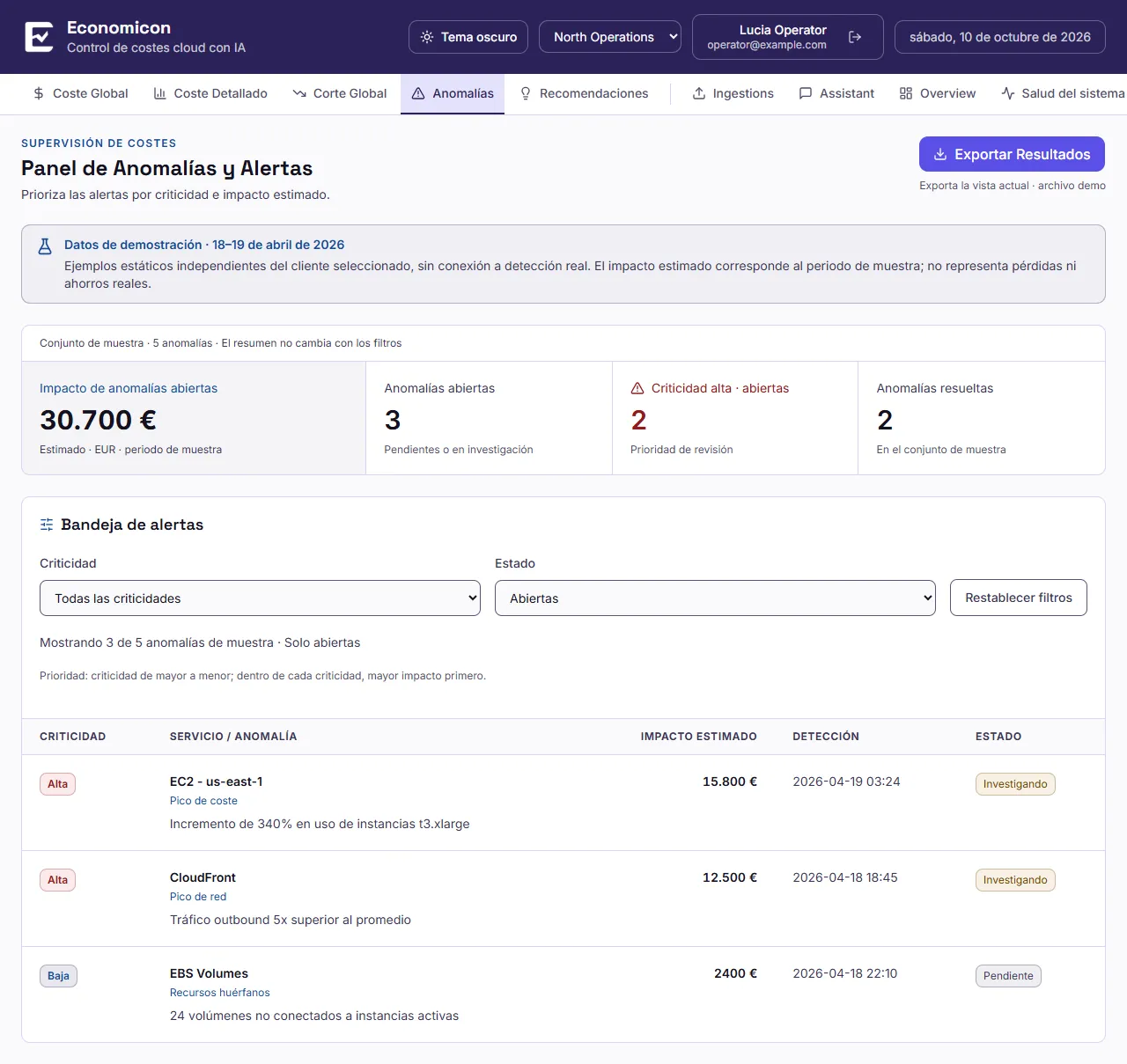
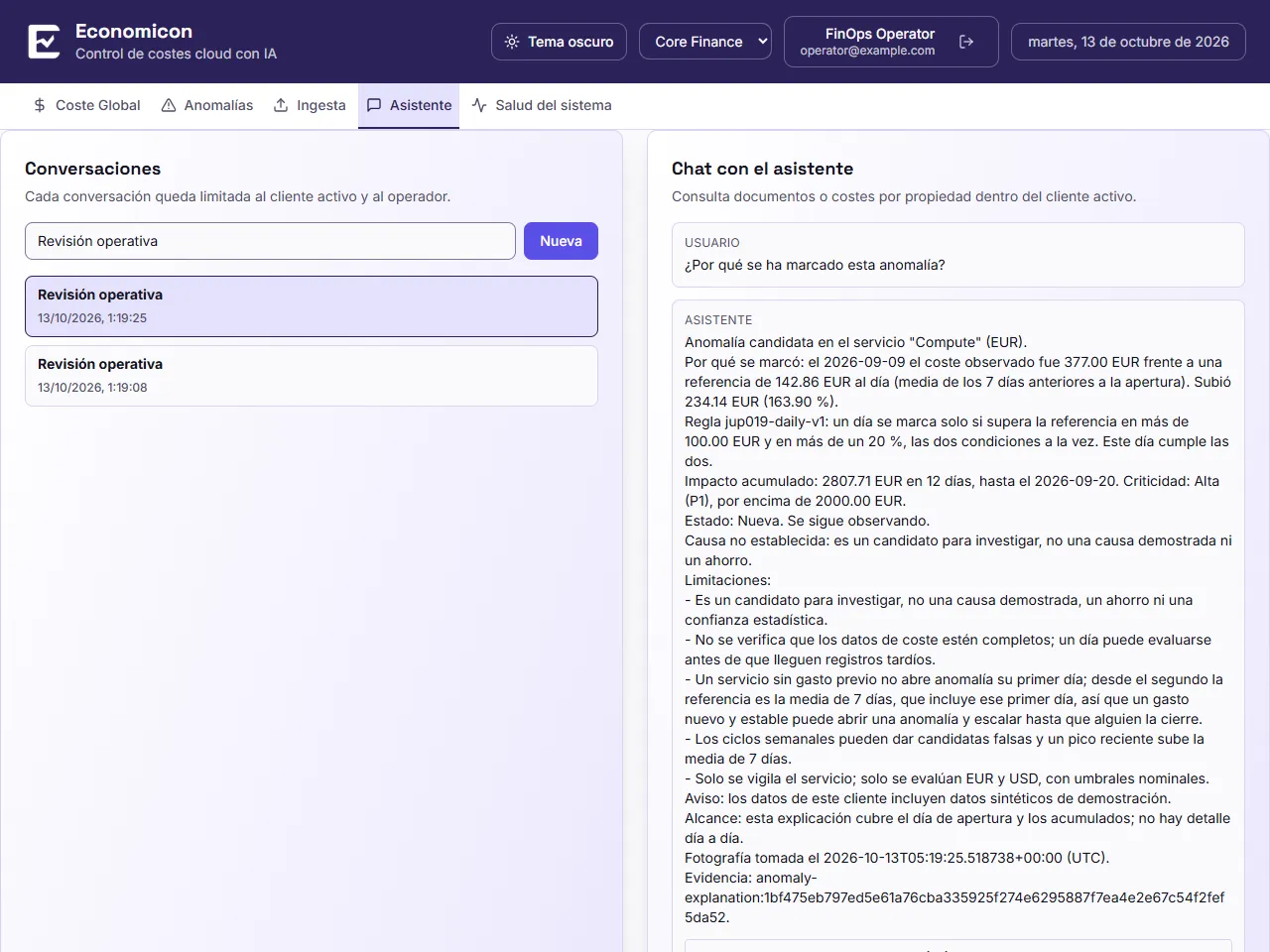
1 · 2026
Economicon, a FinOps assistant
A multi-tenant assistant that ingests Azure costs and answers natural-language questions using semantic retrieval scoped to each customer. My master’s thesis, built as a team.
Interface
- React frontendJWT and X-Tenant-Id on every request
API
- FastAPI backendauth, mandatory tenant, chat with retrieval
Processing and AI
- RabbitMQconfirmed jobs
- Processordocuments and embeddings
- LiteLLMmodel gateway, mock in development
Data
- CockroachDBoperational data and costs
- Postgres + pgvectorvectors scoped by tenant
- MinIOtemporary originals
- Pinned public CSVAzure dataset
- Simulated Azure APICost Management Query subset
- Ingestion CLIpaginated, normalised and idempotent
- CockroachDBcosts per tenant
- Prometheus/metrics from backend and processor
- Grafanadata, anomaly and AI cost dashboards
Problem
Anyone paying for cloud can see the bill, but answering something specific, like which service spiked this month and in which subscription, means exporting data, joining it and understanding the provider’s cost model. Economicon aims to answer those questions conversationally, with one non-negotiable rule: a customer must never see another customer’s data.
Approach
A Turborepo monorepo with four apps, each with a single responsibility:
- frontend (React + TanStack Query): the UI and the chat.
- backend (FastAPI): authentication, mandatory resolution of the active tenant, operational persistence in CockroachDB and vector context retrieval, always scoped by tenant.
- processor: consumes RabbitMQ jobs, generates embeddings and stores them in Postgres with pgvector.
- azure-cost-api: simulates the subset of the Azure Cost Management Query API used by the product, so the whole team can build and test without a real subscription.
Models are accessed through a LiteLLM gateway. In development and tests, explicit mock providers make it possible to run the full stack without API keys.
Infrastructure was treated as part of the product: unprivileged containers with read-only filesystems, base images pinned by digest, formal migrations for both databases, and GitHub Actions CI that checks governance, specs (OpenSpec), tests and build on every pull request.
Results
- Paginated, idempotent per-tenant cost ingestion from the simulated API.
- Chat with tenant-isolated semantic retrieval, in mock mode and with real AI through the gateway.
- A local smoke test covering the minimum end-to-end path: health of all four services, login, cost ingestion, cost summary and a job that travels through RabbitMQ to the processor.
- Architecture, ADRs, roadmap and evidence documented and versioned alongside the code.
Still pending, as the repository states: cloud deployment, advanced observability and an end-to-end validation of the RAG flow with real embeddings and LLMs.
What I learned
Tenant isolation has to be designed from the very first migration rather than bolted on later: tenant_id shapes
the schema, the vector queries and the tests. I also learned that teamwork on a monorepo only scales with explicit
rules: cards, short-lived branches, pull requests and a CI that nobody can skip.